
Your Stellar Startup Fundraising Process Starts Here
When I was first raising money as a co-founder of a Minneapolis-based sports tech startup, I truly didn’t understand the investor mindset.
As a founder, you are so focused on your one idea, and you see the potential for greatness, and you don’t understand why people JUST DON’T GET IT and why can’t they WRITE A DAMN CHECK ALREADY????
It feels truly frustrating, especially if you are in a smaller ecosystem with fewer angel investors or people who get startups.
But here’s the thing. Investors, regardless of geography, are seeing the startup ecosystem with a wide lens. They are seeing dozens, hundreds, even thousands of companies.
Your idea and vision will never be as important to them as they are to you. They have plenty of other things competing for their time and attention.
If they are an angel investor, they might have a big job, a family and lots of other obligations that are competing for both their attention and their money. (Or they might just be planning their next Bali or Burning Man trip.)
If they are a small VC fund, they are seeing hundreds or thousands of deals and also spending a lot of time raising money from LPs (the people/entities that invest in funds).
Professional investors, in particular, are having tons of meetings every day, all the time. It’s their job to meet new people constantly.
Investors also talk to each other ALL THE TIME. I’m in a bunch of WhatsApp groups and way too many Slack groups for investment fund managers.
You need to know that we chat. We are also constantly hanging out at conferences, dinners and happy hours together. Often, good founders and good companies will “rise to the top” of the conversation and investors will hear about you from multiple sources.
That’s always what you want – and you DON’T want someone to chime in to the group chat with a story about how you were a jerk to their associate or ghosted them during a term sheet negotiation.
Investors are looking for reasons to say no. They have an investment thesis, and it should be narrow enough that it’s clear when it’s a no.
So the trick is to figure out how to:
Stand out (in a good way),
Not unintentionally annoy them or disqualify yourself from consideration, and
Start building a good ongoing relationship and a good reputation.
How can you do all of these things? Let’s start by getting into investor psychology a little bit.
Human Brains Are Terrible With Uncertainty and Complexity
At baseline, investors fear making a mistake and investing in the wrong company. They could be afraid of getting duped by an unscrupulous founder (see, e.g., Theranos, FTX, etc.). Nobody wants that attached to their name or reputation.
If VCs or CIOs (Chief Investment Officers) manage other people’s money, they are afraid of losing that money or not getting a big enough return with investments that do succeed.
The thing about investing is that it’s rife with uncertainty and complexity. Especially at the earliest stages, no one really knows what could happen in the decade or so in between a pre-seed investment and a potential IPO. (Ignore anyone who says they have a functioning crystal ball.)
As a result, human brains faced with early-stage investment decisions often resort to primitive decision-making pathways.
As Nobel Prize-winning economist Daniel Kahneman explains in his book, “Thinking Fast and Slow,” human brains are not set up to handle uncertainty and complexity.
Instead, our brains generate “heuristics” that help us make hard decisions using intuitive shortcuts.
I wrote about some of the heuristics that lead our brains to make bad decisions under uncertainty in a previous article, and these three are super relevant to early-stage investing:
Availability Heuristic: Making decisions based on the ease with which instances or occurrences can be recalled. It’s easy to bring to mind an image of a white, bro-tech billionaire, but much harder to name a unicorn company founded by a woman CEO.
Affect Heuristic: Decisions are guided primarily by feelings of liking and disliking, with little deliberation or reasoning. People are much more likely to be friends with and be comfortable with people who are like them.
Representativeness Heuristic: Also known as pattern-matching, this is when we make a decision by assessing how similar something is to an existing mental prototype. This is the fallacy famously identified by Michael Lewis in “Moneyball.” Professional baseball scouts used to (poorly) forecast a player's potential success based on their “build and look.” The same goes in investing.
Understanding the investor psychology at play here can help you, as a first-time founder:
play the game better; and
detach a bit from the feelings of rejection that inevitably come with the fundraising process.
It’s Your Job To Get Investors Past Their Default “No”

Did you know my beloved Oregon Trail game was invented in Brooklyn Center, Minnesota?
So, now we know that:
Investors are generally overwhelmed by a constant flow of new information
Investors are busy doing all the things
Investors are always back-channeling about potential deals
Investors are afraid
Investors have human brains that make it tough for them to invest in the innovative outliers that VC is supposed to be about because it *feels* safer to invest in the same-old, same-old…
And all of this means that, for investors:
Saying no is MUCH, MUCH, easier than saying yes. So…
If the vibes are off, it’s a no.
If you accidentally or unintentionally say something instantly disqualifying, it’s a no.
If it’s the wrong time in the fund cycle, it’s a no.
If an angel investor says yes but later decides to allocate funds to building a new deck at their lake house instead of an angel investment, it’s a no. (This one happened to me!)
It’s almost always a no, even if they take a meeting.
It might be a no, even if they initially say yes.
This is what we call fundraising math: Assume at least 99 nos for 1 yes.
So what do you do here? First, you embrace reality. And the reality is that for most founders, fundraising is hard and it’s a slog.
You are on the Oregon Trail. Starvation, dysentery, and cholera are waiting for you. Don’t even get me started on caulking the wagon.
Having traveled this trail, I know that it’s critically important to be aware that you are ACTIVELY CHOOSING a truly arduous path. It’s important that you don’t waste energy being mad about how hard the path is or wishing the path were different. You can totally turn around or take a break or ask for help, but it’s just a waste of energy to be mad at the path. The path doesn’t care if you are mad, and you need that energy to survive.
Next, you accept that in order to succeed on a treacherous trail, you need support and preparation. You need the right supplies, the right team, the right weapons (to bag an elk or two), a thick skin, and a healthy mindset. That’s where Base Layer can help.
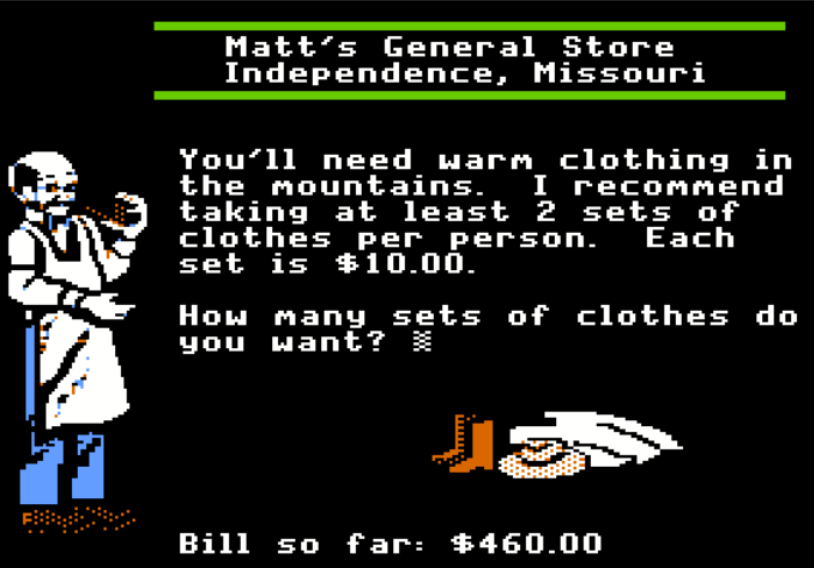
Matt helped the pioneers with their base layer!
*****Short PSA / Rant: You can also decide to dip out here! Just because fundraising is hard doesn’t mean it’s necessarily worth it. Chances are slim, and most fall LONG before they get to the end of the trail. You have choices. Build a different kind of business. Rely on revenue! Build slowly! Think about loans, grants, or other ways of building your company. Ignore investors. THAT IS OKAY. Building a slow-growing, sustainable, durable business might not sound exciting – and it’s certainly not easy – but it is always an option. You’ll still want a solid base layer for your business, but always remember YOU ARE IN CHARGE AND YOU CAN DO WHAT YOU WANT.******
Ok rant over. Let’s assume we are going forward with this arduous fundraising journey. We’re packing the wagon. I’ll help you figure out what you need to bring.
Base Layer Is Designed To Help You Convince Investors To Invest In Your Business
Base Layer is a strategic 1:1 advisory designed to help you, a first-time startup founder, develop what you need under the hood of your business to attract investors, bankers and buyers.
You need to know how to create and protect financial value in your company because that's what investors, bankers, and buyers are looking for. And you need to know how to move investors from “no” to “heck yes!”
This process is based on my 15+ years of experience working with diverse founders as a business attorney, startup founder, accelerator director, and venture fund manager.
I know Base Layer works; I’ve seen firsthand what it can do for the dozens of founders who I have personally supported using this framework.
I developed the first version of Base Layer (back then, known as Lunar Everywhere) in conjunction with Minnesota’s first inclusive accelerator, Lunar Startups, and our 77 amazing Lunar cohort companies. Base Layer has also supported our Tundra Ventures portfolio founders.
In addition to helping attract outside capital, Base Layer also helps founders:
Save money
Increase business survivability
Avoid common, business-killing mistakes
Impress business associates with founder savvy, and
Increase confidence and ability as a startup CEO.
Today, Base Layer is part of my firm Tundra Ventures' advisory practice.
The Base Layer Path To Impressing Investors: You Can Tailor The Experience To Your Specifications (Yes, It’s Like Creating Bespoke Long Underwear)
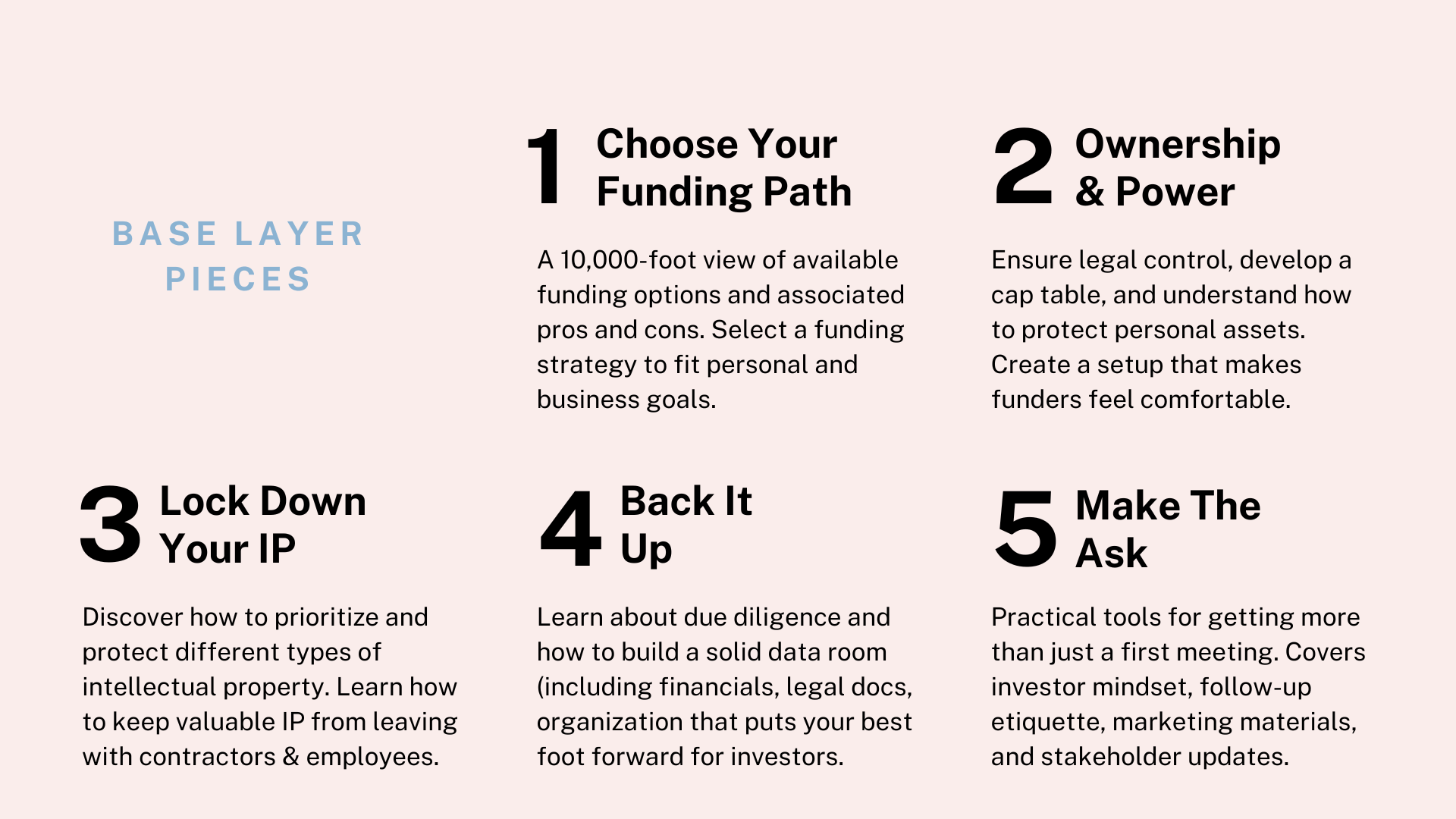
Choose Your Funding Path: A 10,000-foot view of available funding options and associated pros and cons. Select a funding strategy to fit personal and business goals.
Ownership & Power: Ensure legal control, develop a cap table, and understand how to protect personal assets. Create a setup that makes funders feel comfortable.
Lock Down Your IP: Discover how to prioritize and protect different types of intellectual property. Learn how to keep valuable IP from leaving with contractors & employees.
Back It Up: Learn about due diligence and how to build a solid data room for prospective funders (including financials, legal documents, market research, and more).
Make The Ask: Practical tools for getting more than just a first meeting. Covers meeting and follow-up etiquette, marketing materials, and stakeholder updates.
Because I’ll be providing 1:1 implementation support, we’ll prioritize the parts of the framework that are most urgent for your business while also ensuring we address every piece over time.
This is the kind of specialized guidance you can’t Google or get from ChatGPT. You and your business are unique, and you need personalized advice to navigate the always-dangerously-icy startup terrain. (It’s never summer in startupland.)
We’ll start where it’s most helpful and move at a pace that fits your timeline. You’ll also have 24-7 access to a searchable digital support platform.
Learning the Art of the Ask: How to Get VC Funding For Your Startup
Raising capital isn’t just about having a great idea. It’s about knowing how to navigate the investor landscape, build relationships, and position your company as a strong investment opportunity.
I use the Base Layer framework as a guide to make sure nothing is falling through the cracks, but everyone’s fundraising path is highly personal.
For example, in just the past year, I have:
Helped a founder raise a bridge round after an anchor investor unexpectedly dropped out,
Talked a founder through a multi-million dollar seed raise from start to finish,
Helped a founder figure out how to position a potential deal-killing situation as a benefit to new investors, and
Advised on countless pitch decks, explaining to many whip-smart founders how and why their deep expertise and knowledge about their industry needs to be transformed into something a 10-year-old can immediately grok.
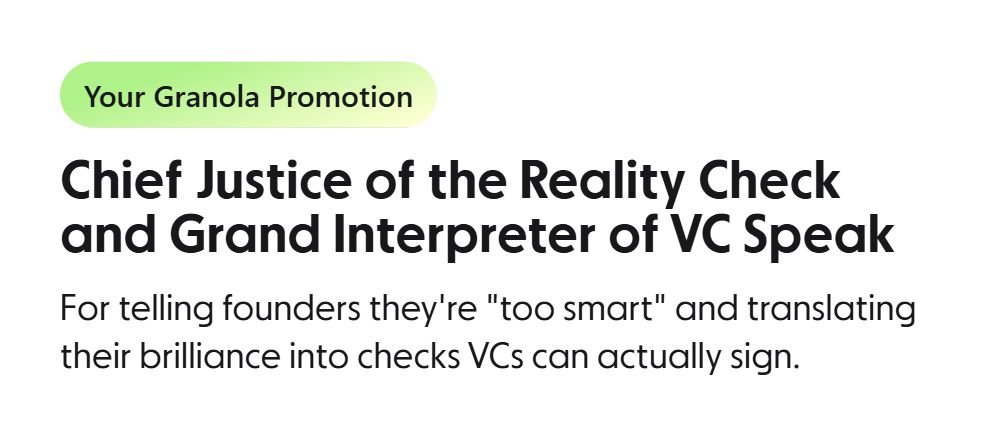
From my 2025 Granola Crunched. I felt seen.
Below are some of the pieces of the “Make The Ask” portion of the Base Layer process. Investor relationship building is a learned skill and is where I spend the most time with founders.
1. The Investor Mindset: Understanding How Investors Think
As we discussed in detail above, one of the biggest mistakes founders make is assuming that investors will see their startup through the same lens they do.
You’re laser-focused on your vision, but investors are looking at hundreds, if not thousands, of deals. Their job is to evaluate risk, find opportunities with the highest potential returns, and avoid getting burned.
Whether they’re angel investors, venture capitalists, or fund managers, they have limited time, competing priorities, and specific investment theses that dictate which opportunities they pursue.
With a hands-on approach, we will work together to:
Shift your perspective to understand an investor’s priorities and constraints.
Avoid common mistakes that make investors say “no” before you’ve even finished your pitch.
Build credibility and differentiate yourself in a crowded field.
2. Crafting the Perfect Investor Blurb: Making Your First Impression Count
First impressions matter, and when it comes to investor outreach, your initial email or introduction is critical. Investors are flooded with pitches, so your message needs to be clear, concise, and compelling.
Your blurb also needs to include all the relevant details that investors use in their 5-second mental triage to determine whether they will invest any serious brainpower or time in your pitch.
I’ll walk you through the best practices for writing an effective investor blurb and help you craft a great one. We’ll go through:
How to structure your message for maximum impact.
The power of using a bullet-point format to make your ask scannable.
What details to include (and what to leave out) to spark interest.
How to create a “forwardable” message that your network can easily share.
3. Ask Etiquette: Run A Professional Startup Fundraising Process
Once you’ve captured an investor’s interest, the next step is securing a meeting. But that’s just the beginning—you also need to handle the logistics, make a strong impression, and follow up appropriately.
As part of our 1:1 work together, I’ll help you learn:
How to make it easy for investors to say “yes” to a meeting.
The etiquette of scheduling and preparing for investor conversations.
Common pitfalls that make investors lose interest.
The importance of follow-up and how to do it right.
When I’m cc’d or b’ccd on founder comms to investors, I often see mistakes that they don’t even realize they are making. We’ll turn those red flags green.
4. The Pitch Deck: Selling the Right Vision Get VC Funding For Your Startup
A well-crafted pitch deck is the most obviously necessary tool in your fundraising arsenal.
Too often, founders make the mistake of creating decks that focus too much on product details rather than what investors actually care about—growth potential and return on investment.
As we go through your pitch deck, we’ll touch on:
How to successfully transition from a sales deck to an investor pitch deck. Less about the problem, less about the solution, MORE about signals that show traction and potential for explosive growth.
What elements must be included in your investor deck, including a few that investors want to see but most don’t put in the deck. This includes explaining how your startup *actually makes money* and every piece of evidence that other people think your startup is as good as you think it is. Investors love knowing who else is in.
How to simplify and refine your presentation to keep investors engaged. The crowded slides have to go. Put the details in the appendix. The deck is just to get the next conversation. What will folks remember after they see the deck, and how will they explain it to their investment partner?
When I’m helping with a pitch deck, I always have founders record our conversation. Inevitably, the best tidbits are in founder responses to follow-up questions.
During a deck review, I’ll stop you and point out that what you just said in the moment is actually the best way to communicate your value proposition, *not* the jargon in your slides. Then, you can go back and update the deck with the gems that dropped out of your mouth.
5. Following Up and Stakeholder Updates: Building Long-Term Trust Via The Startup Fundraising Process
Getting an investor meeting is one thing; keeping check writers engaged on the way to a wire transfer is another.
FACTS: Many (if not most) investors need time to warm up before they write a check.
One of the best ways to build trust with a future investor is through consistent, professional follow-up.
This section covers:
Best practices for tracking investor conversations (using a CRM or simple spreadsheet).
How to create a follow-up cadence that keeps you top-of-mind without being annoying.
The value of regular stakeholder updates and how to structure them effectively.
How to use investor updates to turn hesitant investors into committed ones over time.
Investors like to harp on the importance of investor update emails. Still, these update emails often seem kind of pointless to many first-time founders. I know they did to me! Who has time to write update emails? No one even responds, so what does it matter? Aren’t I just shouting into the void?
And yet… investor updates have a compounding power over time. You say you will do something, you do it. You show your work. You show your ups and downs. You show you are measuring the right things. Investors read the updates, even if they don’t respond.
You build trust and create something investors can circulate among themselves. I can’t tell you how many times I’ve used the update emails as fodder for warm intros to other investors. I won’t tell you who writes the best updates in my portfolio, but I will share the secret sauce of a good update.
Take Control of Your Startup Fundraising Process
Fundraising isn’t just about luck—it’s about strategy, execution, and persistence. And it’s about having a fantastic support system.
Alongside tailored 1:1 support, the Make The Ask pillar of the Base Layer process gives you the step-by-step guidance you need to approach investors with confidence, avoid common mistakes, and maximize your chances of success.
By learning these techniques AS APPLIED TO YOUR SPECIFIC STARTUP, you’ll not only secure more meetings but also convert those meetings into meaningful investment opportunities.
Ready to refine your approach and start closing deals? Let’s get to work.
If you made it all the way down here and you’re interested in premier protection from the icy winds of the startup tundra, here are some ways to dig in further:
If you missed the prior articles in the series, check them out:
Base Layer Overview: How Do I Get Investors To Give Me Money?
Choosing Your Funding Pathway: Sell The Right Vision
Ownership & Power: How To Run A Successful Startup
Lock Down Your IP: The Importance of Intellectual Property (And Why VCs Care)
Back It Up: What Do Investors Look For Before Investing?
Follow me on LinkedIn
**** I don’t use AI to write my posts. But one way I do use it is to help me summarize my posts into FAQ sections like the one below so that the bots can find my work. It’s a good summary!****
Frequently Asked Questions About the Startup Fundraising Process
What is a startup fundraising process?
A startup fundraising process is the structured system a founder uses to prepare for, approach, and engage investors over time. It includes understanding investor psychology, positioning your business clearly, preparing the right materials, managing outreach and follow-up, and maintaining credibility throughout the relationship. A strong startup fundraising process reduces investor uncertainty and dramatically improves your ability to convince investors to invest in your business.
How do you convince investors to invest in your business?
To convince investors to invest in your business, you must make it easy for them to say yes. That means clearly communicating your vision, demonstrating credibility, reducing perceived risk, and showing that you understand how investors make decisions. Investors are overwhelmed and risk-averse by default, so founders who run a professional, well-organized fundraising process stand out and earn trust faster.
Why is understanding the investor mindset so important for founders raising their first round of institutional capital?
Many first-time founders struggle because they assume investors view their startup the same way they do. Founders are emotionally attached to one idea; investors are evaluating hundreds of opportunities at once. Without understanding investor mindset, founders often say or do things that unintentionally trigger a quick “no,” even when the business itself has real potential.
How does a strong startup fundraising process help you raise money?
A strong startup fundraising process helps you raise money for a startup by creating clarity and consistency for investors. It ensures that your outreach, pitch, follow-ups, and updates work together to build momentum over time. Instead of relying on luck or a single meeting, you create multiple opportunities for investors to warm up, ask questions, and eventually commit capital.
How do investors decide whether to say yes or no?
Investors are constantly filtering opportunities and are looking for reasons to say no. Human brains struggle with uncertainty, especially at early stages where outcomes are unclear. If your messaging is confusing, your process feels sloppy, or your follow-up is inconsistent, it increases perceived risk. A clean, thoughtful fundraising process helps investors feel confident saying yes.
How can first-time founders improve their chances of getting VC funding?
If you want to know how to get VC funding for your startup, start by recognizing that venture capital is highly selective and pattern-driven. Founders improve their odds by:
Understanding investor incentives and constraints
Avoiding common fundraising mistakes
Communicating their business in a simple, credible way
Running a disciplined, professional startup fundraising process
VC funding is rarely about one perfect pitch—it’s about sustained execution and trust-building.
What does it mean to run a professional startup fundraising process?
Running a professional startup fundraising process means treating fundraising like a core business function. This includes clear investor outreach, respectful scheduling, strong meeting preparation, timely follow-ups, consistent investor updates, and accurate tracking of conversations. Professionalism makes it easier for investors to advocate for you internally and with their networks.
What is the Base Layer process?
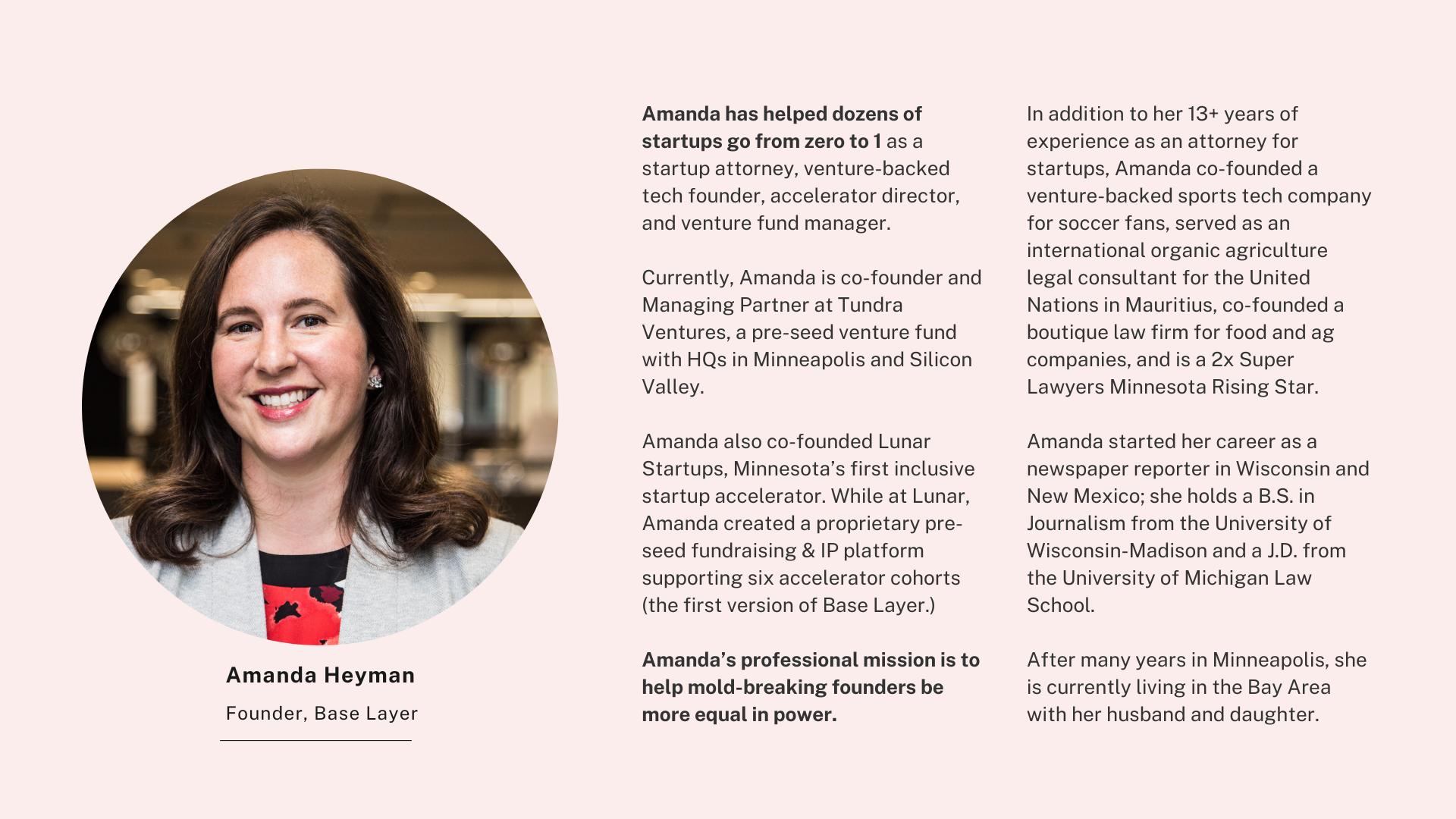
The Base Layer process is a milestone-based, 1:1 strategic advisory framework designed by Amanda Heyman to help first-time founders build investor-ready businesses from the inside out. It covers choosing a funding pathway, ownership and power, intellectual property, due diligence readiness, and Make The Ask—the pillar focused on executing a strong startup fundraising process and convincing investors to invest in your business.
Who is Amanda Heyman?
Amanda Heyman is a venture fund manager, former startup attorney, accelerator director, and the creator of Base Layer. She is the Co-Founder and Managing Partner of Tundra Ventures and has spent over a decade helping founders navigate how to raise money for a startup, understand investor psychology, and run effective startup fundraising processes.
Is raising venture capital the right choice for every startup?
No. Venture capital is a high-risk, high-pressure path that isn’t right for every business or founder. Many successful companies rely on revenue, loans, grants, or slower growth strategies instead. Understanding your options—and choosing intentionally—is a critical part of building a sustainable business and deciding whether your goal is to raise VC funding or pursue a different path.