
How To Raise Money For A Startup: Sell The Right Vision
Not too long ago, I was attending a conference for women venture fund managers at a ritzy hotel in downtown San Francisco. Under the sparkling lights of the crystal chandeliers, dozens of women VCs gathered to gain industry insights and pitch a select group of funders who invest in venture funds (known as LPs.)
At this event, an enterprising young woman startup founder was volunteering for the organization running the conference. (Side note, this is a super smart way to be one of the only founders in a room full of investors.)

I was chatting with a VC friend when this woman came up to us, smiling, and introduced herself. She was clearly bright, had an interesting startup idea in the regenerative agtech space, and had an engaging personality. I was happy to talk to her.
We talked for maybe five minutes, and I can’t remember how it came up, but she casually mentioned that she never wanted to sell her startup business. She wanted to own it in perpetuity.
And….with that simple statement, she instantly disqualified herself from VC investment consideration.
As soon as this founder said she didn’t ever want to sell, I could feel my VC friend thinking the same thing I was thinking. Basically… “should we tell her?” We just met this woman, we don’t want to rain on her parade, and we don’t want to be jerks…but there is no way she can get VC funding if she doesn’t want to sell.
And that means she is probably wasting her time at this conference. (Why? Spoiler alert for what’s to come, but VCs only make money if the companies they invest in sell or go public.)
Neither of us said anything. We walked away into the next session, had a whispered conversation about what just happened, and agreed we were both on the same page. We didn’t want to have the uncomfortable conversation, we were exhausted from being on the fundraising circuit ourselves (yes, VCs have to raise money, too!), and we just let it slide as we trudged into the next panel discussion.
How I could have helped her get VC funding for her startup
I regret not telling this bright young founder what I was thinking.
I could have found her later on and said something like: “Hey, I liked your startup mission and I don’t want to make any assumptions about your business strategy, but I just wanted to let you know that if you tell practically any venture capital fund manager that you don’t want to sell your business, they can never invest in you.” And then we could have had a conversation from there.
I was (Minnesota?) nice, when I could have been kind. The kind thing to do would have been to let her know the rough outlines of what I will tell you in the remainder of this blog post. Which is that the vision you have for your business will largely dictate who will be willing to invest in your business.
And that means you need to understand what funding pathways are available to startup companies. You need to know what it means to go down one path vs. another, and what the pros and cons are of each. When you understand the broader universe of funding, you can avoid making the mistake that this young founder made in telling a couple of VCs that she never wanted to sell her business.
***As another aside, never wanting to sell your business is PERFECTLY FINE. Never wanting to take on outside investors, especially venture capital investors, is also PERFECTLY FINE. For the vast majority of business owners, avoiding investors can be a smart call!***
Still, if you have (or want to have) the kind of startup that can attract investors, you need to (as a very basic starting point) say the right things to the right people. Your funding pathway should determine how you position yourself.
Read on to learn more about how to pick a funding pathway and how to set yourself up for success on your chosen path.
How To Raise Money For A Startup: Get Your Funding Pathway Figured Out Before You Start Talking to Investors
The first pillar of my Base Layer framework — Choosing a Funding Pathway — is designed to give first-time founders a 10,000-foot view of available funding options and their associated pros and cons. It’s all about selecting the right funding strategy to fit your personal and business goals.
Don’t waste time going down a path to nowhere. It’s the worst.
Instead, make your life infinitely easier by snagging a spot in my new 1:1 strategic advisory (part of the new Tundra Ventures advisory practice)!
Base Layer is a process designed to help you, a first-time startup founder, develop what you need under the hood of your business to attract investors, bankers and buyers.
You need to know how to create and protect financial value in your company because that's what investors, bankers, and buyers are looking for.
This process is based on my 15+ years of experience working with diverse founders as a business attorney, startup founder, accelerator director, and venture fund manager.
I know Base Layer works; I’ve seen firsthand what it can do for the dozens of founders who I have personally supported using this framework.
I developed the first version of Base Layer (back then, known as Lunar Everywhere) in conjunction with Minnesota’s first inclusive accelerator, Lunar Startups, and our 77 amazing Lunar cohort companies. Base Layer has also supported our Tundra Ventures portfolio founders.
Also, in addition to helping attract outside capital, Base Layer also helps founders:
Save money
Increase business survivability
Avoid common, business-killing mistakes
Impress business associates with founder savvy, and
Increase confidence and ability as a startup CEO.
Today, Base Layer is part of my firm Tundra Ventures' advisory practice.
The Base Layer Path To Impressing Investors: You Can Tailor The Experience To Your Specifications (Yes, It’s Like Creating Bespoke Long Underwear)
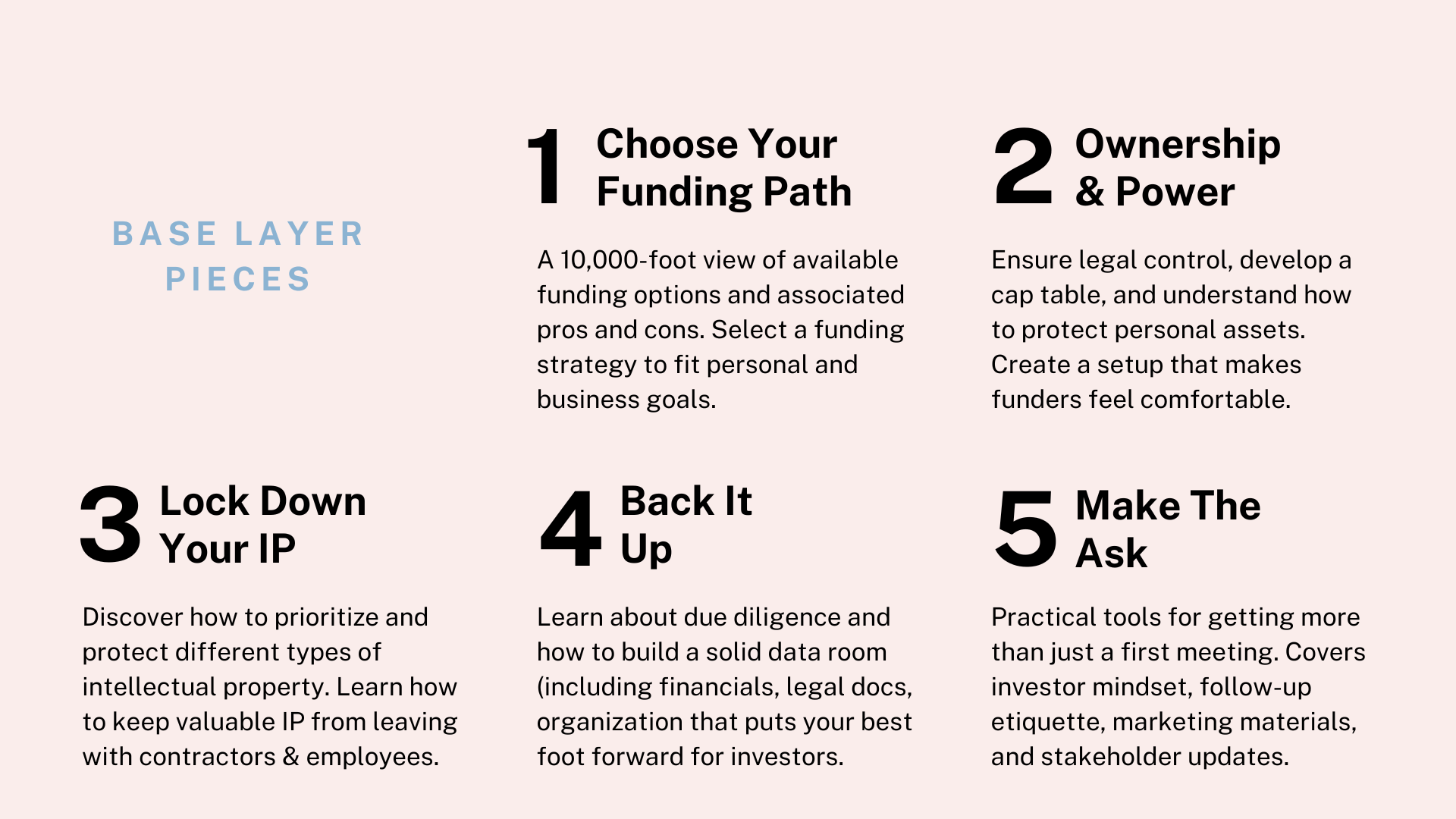
Choose Your Funding Path: A 10,000-foot view of available funding options and associated pros and cons. Select a funding strategy to fit personal and business goals.
Ownership & Power: Ensure legal control, develop a cap table, and understand how to protect personal assets. Create a setup that makes funders feel comfortable.
Lock Down Your IP: Discover how to prioritize and protect different types of intellectual property. Learn how to keep valuable IP from leaving with contractors & employees.
Back It Up: Learn about due diligence and how to build a solid data room for prospective funders (including financials, legal documents, market research, and more).
Make The Ask: Practical tools for getting more than just a first meeting. Covers meeting and follow-up etiquette, marketing materials, and stakeholder updates.
Because I’ll be providing 1:1 implementation support, we’ll prioritize the parts of the framework that are most urgent for your business while also ensuring we address every piece over time.
We’ll start where it’s most helpful and move at a pace that fits your timeline. You’ll also have 24-7 access to a searchable digital support platform.
Choosing Your Funding Pathway: Unlocking the Right Strategy for Your Startup Fundraising Process
When we work together, I’ll help you strategically select the most appropriate funding pathway for your startup, ensuring that you set yourself up for success while aligning your business vision with the right type of investor or funding source.
Understanding your options will empower you to take control of your startup's financial future and shape the direction of your company.
What You’ll Learn About The Ways A Company Can Raise Capital
We’ll talk through the spectrum of funding options, from equity investment (raising money from investors) to non-equity options (debt, bootstrapping) and everything in between, helping you get a 10,000-foot view of the choices available.
And then we’ll pick the best path forward.
We’ll explore:
The key requirements and consequences associated with different funding types.
The essential tools you'll encounter when negotiating and securing funds.
How to develop a strategic approach to your funding based on your business model, goals, and personal preferences.
I constantly talk to founders who believe they have a VC backable company when, in fact, they don’t. This isn’t because they have a bad idea or a bad business.
It’s because venture capital is: 1) the most extreme form of fundraising in the world; 2) requires the potential for (multi) billion dollar outcomes; and 3) requires your company to match an extremely specific archetype. And that’s before we even get to the stats on founder gender, race, or alma mater.
Why It’s Important To Understand The Ways A Company Can Raise Capital
The way you bring money into your business also has significant implications for your future as a founder. From ownership stakes to power dynamics, the right choice of funding affects:
Ownership and Control: Are you willing to share equity (and power) in your company, or do you prefer to keep control with bootstrapping? Once you get to a certain level of VC funding, you’ll be required to cede some decision-making power to your Board of Directors.
Eventual Payoff: Whether you go the equity investment route or bootstrap your way to success, the structure of your funding will impact how much you can eventually profit and how quickly you will be expected to move toward a potential payoff (usually via selling the company). Are you prepared to move as fast as possible toward liquidity for your investors?
Your Personal Finances: Funding strategies can also determine your ability to pay business and life expenses—and this will quickly become far more important than you might initially think. I’ve been down this road myself; you have to plan for how to cover childcare, housing, and healthcare costs as you enter the entrepreneurship vortex. “I’ll just quickly raise some money,” is almost never the answer.
Shaping Your Startup Fundraising Process: Investors vs. Bootstrapping (or both?)
As we create your strategic fundraising plan, one key decision is whether to pursue equity funding from investors, opt for a bootstrapping approach, or figure out a blend of both.
Each path has its advantages and challenges. Here’s a sneak peek:
Equity Investment Track: If you choose this path, you'll bring in investors who exchange capital (money) for ownership in your company. This route is ideal for companies with the potential to scale rapidly, but it comes with a price: you’ll need to share control and your eventual exit (sale of the company) will likely be driven by investors looking for significant returns.
Bootstrapping Track: With this option, you fund your business using loans, grants, and/or your own revenue or other sources of income. You maintain full ownership and control, but you’ll need the ability to 1) generate enough revenue to cover expenses and/or 2) repay debt funds—whether through personal assets or business revenues.
Each option suits different types of companies depending on their growth goals, cash flow requirements, and willingness to share ownership in the company.
How To Raise Money For Your Startup: The Flexibility of Funding Options
While you might lean toward one funding pathway or the other, it’s important to recognize that many successful companies blend equity, debt, and bootstrapping strategies. (These days, there’s even the “seedstrapping” option to consider; I think this one can be great, actually.)
For example, you could bootstrap in the early stages, building a solid foundation, and then later raise equity funding as you scale. In fact, this dual approach can often be a sweet spot, allowing you to maintain control when needed while leveraging investors for later-stage growth.
However, it’s crucial to remember that once you go down the equity path with VCs, it’s tough to go back. VC investors come with their own set of expectations—chiefly, the need for a significant exit (meaning a sale of the company that returns funds to investors).
This is why it's vital to define your long-term vision early and choose your funding pathway with both your business's needs and your personal preferences in mind.
Selling Your Vision: Are You Backable or Bankable?
A critical part of the funding decision is how you frame your business vision. This will directly influence whether you’re seen as backable (suitable for equity investment) or bankable (suitable for traditional funding like loans).
Backable: If your business plan is designed for high growth and eventual exit (e.g., IPO or acquisition), you’re selling an "equity" vision. Here, investors are betting on the company’s future value, and you need to articulate how they’ll see their investment grow. In particular, you need to have a credible plan to get your company to at least a billion dollar valuation.
Bankable: On the flip side, if your goal is steady revenue and paying back loans, you’re selling a “bankable” vision. Debt investors like banks will expect repayment with interest, typically in exchange for more predictable returns.
Again, these two strategies are not mutually exclusive. You can be both backable and bankable, leveraging debt and equity as you see fit.
However, keep in mind that many tech startups aren’t bankable at the beginning because they have no revenue and no assets. You might be personally bankable because you have personal assets (like a house or a car) that you can put up as collateral for a loan, but this can be a super risky play.
Key Takeaways Re: How To Get VC Funding For Your Startup By Choosing The Right Funding Pathway For You
Very early in our time working together 1:1 through the Base Layer process, you'll be able to:
Identify which funding pathway best suits your business and personal goals.
Create a funding strategy that aligns with your vision and prepares you for successful investor conversations.
Avoid unintentionally disqualifying yourself from investment consideration.
Better understand how to speak the language of investors, from SAFEs to convertible notes to the stages of funding rounds.
Confidently chart the best individual path toward success for *you* (not those other dudes, but what works best for you, your life, your family, and your goals.)
Whether you're bootstrapping or raising venture capital, choosing the correct funding pathway is a crucial step in building a sustainable business.
Our work together arms you with the knowledge you need to choose wisely, giving you flexibility and control over how you grow and fund your startup. Make your choice strategically—your path ahead depends on it.
So, if you’re interested in creating a startup fundraising process that is strong enough to stand up to the icy winds of the startup tundra, here are some ways to dig in further:
Check out the next article in the Base Layer blog series: How To Run A Successful Startup: Conquer Ownership & Power
Follow me on LinkedIn
**** I don’t use AI to write my posts. But one way I do use it is to help me summarize my posts into FAQ sections like the one below so that the bots can find my work. It’s a good summary!****
FAQ: How To Raise Money For a Startup & Get VC Funding
How do I raise money for a startup?
Raising money for a startup begins with choosing the right funding pathway before you ever speak to an investor. The vision you have for your business — especially whether you plan to sell it one day — determines which funding sources will consider you. You need a clear understanding of equity vs. non-equity options, what each requires, and what tradeoffs you’ll face. When your funding strategy aligns with your goals, you avoid wasting time and you set yourself up for successful investor conversations.
What is the best way to get VC funding for your startup?
If your goal is to get VC funding, you must be building a business that has the potential for rapid, massive growth and a credible path to a billion-dollar-plus valuation. Venture capital only works if the company eventually sells or goes public, so if you’re not aiming for a significant exit, you will automatically disqualify yourself in the eyes of investors. To get VC funding, you need to:
Position yourself as backable
Understand how venture rounds, SAFEs, and convertible notes work
Speak the language of investors
Present a vision designed for scale and liquidity
What is the startup fundraising process?
A strong startup fundraising process starts by mapping out your funding options from a 10,000-foot view. You evaluate equity routes (like venture capital) versus non-equity bootstrapping routes (like debt, grants, and bootstrapping) and decide which best fits your long-term objectives. Once you choose a path, you prepare essential elements like legal structure, ownership clarity, IP protection, data room materials, and your investor narrative. Only then do you begin talking to investors or lenders.
What are the ways a company can raise capital?
A company can raise capital through a spectrum of funding options, including:
Equity investment: Venture capital, angel investors, or other investors who provide money in exchange for ownership.
Debt: Loans, lines of credit, or other repayment-based funding.
Bootstrapping: Using personal savings, business revenue, or other income sources to fund operations.
Blended strategies: Many companies combine equity, debt, and bootstrapping, especially early on. For example, “seedstrapping” has gained popularity in recent years.
Each option carries different consequences for ownership, control, financial risk, and expectations for growth.
How do I get funding for a startup if I don’t want VC investment?
If you don’t want to pursue venture capital — which is perfectly reasonable — you can raise money through non-equity approaches. That includes bank loans, grants, revenue-based financing, or simply bootstrapping until the business generates enough cash to fund itself. This path allows you to maintain full control and avoid the pressure of building toward a fast exit.
What’s the difference between being backable and being bankable?
Backable startups are designed for high-growth, high-exit outcomes. Investors are betting on future valuation.
Bankable startups are designed for predictable revenue and repayment. Lenders bet on your ability to pay back debt with interest.
Some founders may fit both profiles, but in early-stage tech — where companies often lack revenue and assets — it’s common to be backable long before you’re bankable as a company.
Why does choosing the right funding pathway matter?
Your funding pathway shapes nearly every aspect of your business and personal future, including:
How much ownership you keep
How much control you retain
How you get paid (and when)
How fast you’re expected to grow
Your personal financial stability during the startup phase
Picking the wrong pathway wastes time and can pull you toward a business model that doesn’t match your goals or lifestyle.
How can I avoid disqualifying myself when raising money for my startup?
Founders often unintentionally rule themselves out by misunderstanding investor expectations. For example, telling a VC you never intend to sell your company instantly removes you from consideration. Avoid this by learning the requirements of each funding type, aligning your vision with the right investors, and presenting a compelling, credible strategy that fits their model.
Can I combine bootstrapping and venture capital?
Yes — many successful companies use a blended approach. You might bootstrap early to build a solid foundation, then raise equity to scale. Or, if you are confident in your ability to drive revenue + liquidity long term with just a bit of startup capital, you might try “seedstrapping” (taking on a small amount of early stage capital and then forego larger funding rounds). That said, once you take venture capital, you generally enter a path with clear expectations: grow rapidly and aim for a sizable exit. It’s not a reversible decision.
How do I know if my startup is a fit for venture capital?
You’re likely a fit for VC if:
You’re building for speed and massive scale
You can credibly articulate a path to a billion-dollar-plus valuation
Your business model aligns with investor return expectations
You’re willing to share ownership and decision-making power
You’re prepared for the realities of board oversight and exit timelines
You are willing to be fundraising for the next [infinity] years
If this doesn’t sound like your goals, another funding pathway may be a better match.
What is the Base Layer process?
Base Layer is a 1:1 strategic advisory and process that helps first-time founders build the internal foundation needed to impress investors, bankers, and buyers. The process covers:
Choosing your funding pathway
Understanding ownership and power
Locking down your intellectual property
Preparing a strong data room and due diligence materials
Learning how to “Make the Ask” through effective investor narrative and etiquette
It’s designed to save founders money, increase survivability, prevent common mistakes, and dramatically increase confidence in navigating the startup fundraising process.
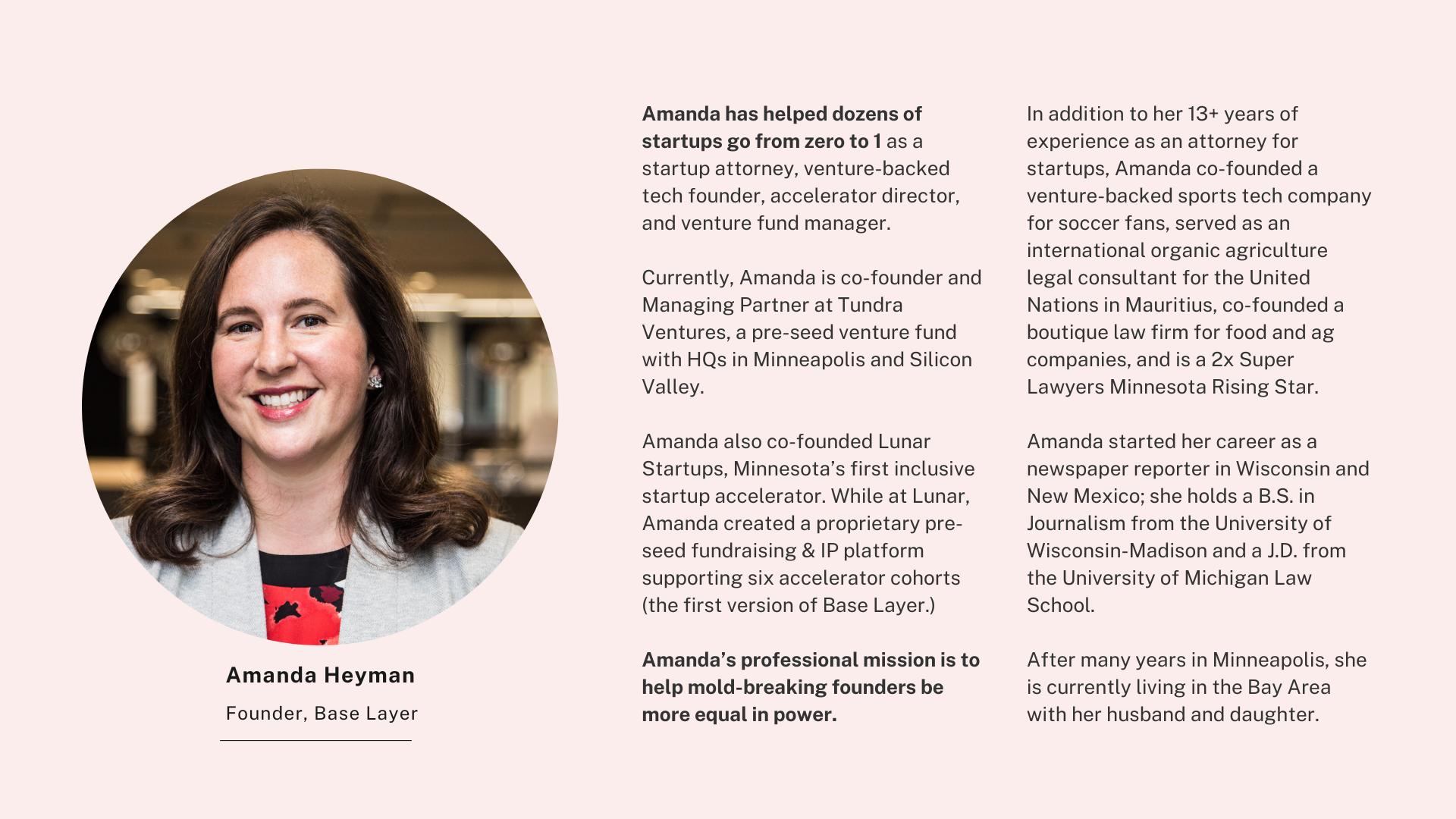
Who is Amanda Heyman?
Amanda Heyman is the creator of the Base Layer framework and a long-time supporter of early-stage founders. Her perspective comes from 15+ years as a business attorney, startup founder, inclusive accelerator director, and venture fund manager.
She has worked directly with dozens of founders—including 77 companies through Minnesota’s first inclusive accelerator, Lunar Startups—and continues to support portfolio founders through Tundra Ventures.
Amanda’s work centers on helping first-time founders build a strong internal business foundation that attracts investors, bankers, and buyers while avoiding the common pitfalls that derail young companies.