How To Run A Successful Startup: Conquer Ownership & Power
If you’re like most founders, you probably didn’t take the time to dot every “i” and cross every “t” when setting up your business. That’s okay—you were focused on building, as you should have been.
Now, though, it’s time to fill in those gaps so that you can build with confidence, impress investors, and avoid the costly, predictable, and *avoidable* mistakes that trip up so many early-stage entrepreneurs.
The list of below are true stories from my 15 years of working with early-stage businesses. And they are the kinds of scenarios that happen again and again…and again, to startups of every shape and size. Some of them even happened to me!
A co-founder suddenly decided to move their family from the U.S. to Norway and wanted to unexpectedly and amicably leave the business in year one.
A shady independent contractor who was initially on track to be a potential co-founder tried to steal the legitimate founder’s company. (They failed, thank goodness, in part due to Base Layer protections.)
Four tech co-founders lost interest in the business early on and left the fifth co-founder to shoulder all the work. The fifth was also left hanging without enough ownership in the business and had to convince the others to restructure. Without the restructure, they were DOA with investors.
A rockstar company lost out on a huge pre-seed investment check in part because they took too long to convert from an LLC to a Delaware C-Corp after they started taking on early investors. It just got too complicated, and the deal withered.
A founder and CEO got kicked out of their own (successful) healthcare company and lost the right to make any decisions going forward. The CEO had no recourse.
A disorganized team of founders mixed up their personal money with business funds, got sued, and were personally liable for six figures of damages because they couldn’t show they were properly running their business independent from their personal lives.
A bright founder in the food space delayed protecting the name of their cheese spread business and had to spend thousands of dollars in attorney fees fighting for the right to use their brand name.
Although these stories sound dramatic, they aren’t outliers. Tales like these are far more common than you’d think.
The great news, though, is that if you know what to expect you can plan for what’s coming.
I know, I know … this isn’t the sexy startup stuff. You won’t be presenting this work on a stage or in a fancy video. But once you get it all figured out you can sleep far better knowing that ownership and power in your business is all buttoned up.
Conquering Ownership & Power in Your Business: Avoiding Startup Mistakes
Building a startup isn’t just about having a great idea—it’s about owning and controlling that idea as you execute and implement.
The Ownership & Power pillar of my Base Layer framework is designed to ensure that, as a founder, you actually own and control the business you worked so hard to create.
We’ll also ensure you have a solid legal foundation that:
protects your business,
keeps decision-making power in the right hands,
shows investors that you know what you are doing, and
positions you for long-term success.
You’ll develop a cap table showing who owns what in the business, and you’ll make sure you understand how to protect your personal assets (house, car, etc.).
Basically, you will create a foundation that can make investors (and you!) feel comfortable with your setup.
Whether you're in the early stages of figuring out how to set up a startup OR have already put some basics in place but need to tighten up your structure, we’ll walk through critical legal and financial principles in a way that’s both clear and immediately useful.
Introducing Base Layer, a strategic 1:1 advisory that goes beyond the pitch deck for startup founders raising their first investor dollars
Base Layer is a process designed to help you, a first-time startup founder, develop what you need under the hood of your business to attract investors, bankers and buyers.
You need to know how to create and protect financial value in your company because that's what investors, bankers, and buyers are looking for.
This process is based on my 15+ years of experience working with diverse founders as a business attorney, startup founder, accelerator director, and venture fund manager.
I know Base Layer works; I’ve seen firsthand what it can do for the dozens of founders who I have personally supported using this framework.
I developed the first version of Base Layer (back then, known as Lunar Everywhere) in conjunction with Minnesota’s first inclusive accelerator, Lunar Startups, and our 77 amazing Lunar cohort companies. Base Layer has also supported our Tundra Ventures portfolio founders.
In addition to helping attract outside capital, Base Layer also helps founders:
Save money
Increase business survivability
Avoid common, business-killing mistakes
Impress business associates with founder savvy, and
Increase confidence and ability as a startup CEO.
Today, Base Layer is part of my firm Tundra Ventures' advisory practice.
The Base Layer Path To Impressing Investors: You Can Tailor The Experience To Your Specifications (Yes, It’s Like Creating Bespoke Long Underwear)
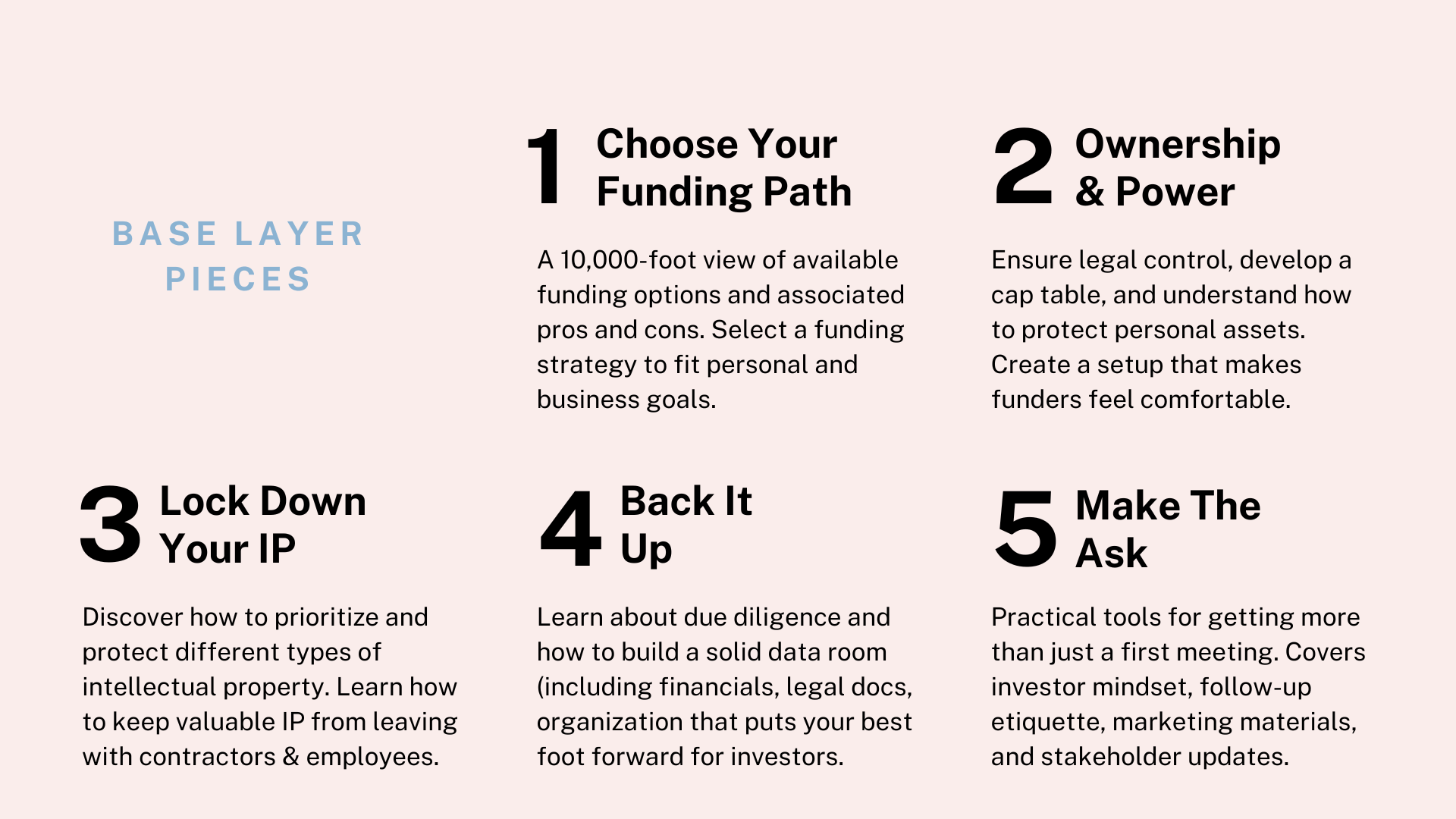
Choose Your Funding Path: A 10,000-foot view of available funding options and associated pros and cons. Select a funding strategy to fit personal and business goals.
Ownership & Power: Ensure legal control, develop a cap table, and understand how to protect personal assets. Create a setup that makes funders feel comfortable.
Lock Down Your IP: Discover how to prioritize and protect different types of intellectual property. Learn how to keep valuable IP from leaving with contractors & employees.
Back It Up: Learn about due diligence and how to build a solid data room for prospective funders (including financials, legal documents, market research, and more).
Make The Ask: Practical tools for getting more than just a first meeting. Covers meeting and follow-up etiquette, marketing materials, and stakeholder updates.
Because I’ll be providing 1:1 implementation support, we’ll prioritize the parts of the framework that are most urgent for your business while also ensuring we address every piece over time.
This is the kind of specialized guidance you can’t Google or get from ChatGPT. You and your business are unique, and you need personalized advice to navigate the always-dangerously-icy startup terrain. (It’s never summer in startupland.)
We’ll start where it’s most helpful and move at a pace that fits your timeline. You’ll also have 24-7 access to a searchable digital support platform.
Why Ownership and Power Matter: How To Run A Successful Startup
Most founders don’t start out as legal experts—and you don’t need to be one. But you DO need to understand how ownership, decision-making authority, and financial control work in your business.
Otherwise, you risk running into serious problems, such as:
Unintentionally giving away too much ownership too early, which can squash any chances you have with investors and make it impossible to run your business
Giving up power over decision-making in your business, letting others benefit from your hard-earned success or run your business into the ground
Ignoring basic steps that could put your personal assets at risk (like your house, car, or bank accounts)
Giving investors the impression that you don’t know what you are doing (most first-time founders don’t, so showing you have your ducks in a row makes you stand out in a good way)
This part of the process helps you avoid these common pitfalls and put your best foot forward.
After we work through the Ownership & Power section of the Base Layer process, you’ll have the knowledge and tools to make confident decisions that protect your business, showcase your savvy, and keep you in control.
How To Set Up A Startup: How The Base Layer Ownership & Power Pillar Gets You Investor-Ready
Again, all of this applies even if you already have a going concern. Most folks didn’t have time to get set up in a way that investors need.
At least 90% of the startups I’ve seen who are seeking pre-seed capital are a hot mess under the hood. Even the ones that look polished from the outside. It’s honestly kind of shocking.
But it’s also an opportunity; having a pristine, investor-ready startup engine is a serious competitive edge – AND it’s one of the few things you can control.
The list below is a highlight reel of what we’ll go through together to help you achieve that kind of edge. If we talk through each piece and everything is buttoned up, great; we’ll move on to other priorities.
(Spoiler: Everything is never buttoned all the way up.)
How to choose and protect a business name
The differences between LLCs and C-Corps—and which one is right for you, including whether a B Corp makes sense
How to structure and maintain a cap table (and what it is, if you are new to cap table management)
Why vesting schedules matter and how to implement them
How to protect your personal assets by practicing right-sized corporate governance and keeping your liability shield strong (this protects you if you get sued)
The importance of business insurance, especially if you sell a product that touches a human body in any way
Let’s dig in a little further on each of these topics.
Choosing and Protecting Your Business Name
Your business name is one of your most valuable assets. But before you invest in branding, check to see if it’s available.
How to Protect Your Name
Search Google, the USPTO database, and state business registries for similar names.
Apply to register a federal trademark with the USPTO if you plan to use your name as a primary brand.
Consider using a DBA (Doing Business As) if you want a separate brand name from your legal entity.
Trademark protection is essential if you want to build a recognizable brand that’s legally protected from copycats.
Don’t fall into the trap of picking a business name that somebody else already owns. You’ll likely have to change the name at some point and will lose your investment in marketing assets (website, materials), branding (logo, labels, tradeshow booths), and brand equity (the public’s knowledge, awareness of, and goodwill toward your brand).
I’ve been down this road myself. My first business was a startup law firm that we called Fare Grange Law. After some legal tangles with another similarly-named organization, we eventually changed our name.
The cute little sprout logo we hired a designer to create and proudly printed on our business cards (yes, business cards, this was 2013) – gone, poof. Our web domain? Useless. Our years of building a reputation under this name? Also gone.
We also had to hire another designer to create a new name, logo, etc. We had to change everything on our legal docs, with the state, and with the IRS. Then, we had to update all of our bank accounts, online subscriptions, social media handles … everything. It was a drag. And a waste of time and money.
Don’t fall into this naming trap. Learn from my mistakes.
2. LLC or C-Corp For Startups: Choosing the Right Business Structure
One of the first critical decisions you’ll make as a founder is selecting the right business entity.
Your choice impacts everything—how you’re taxed, how you are able to raise money, and how much personal liability you take on.
Sole Proprietorship vs. LLC vs. Corporation
Sole Proprietorship: Easiest to set up but offers zero liability protection. Your personal assets are at risk. Nobody will invest in a sole prop.
Limited Liability Company (LLC): A flexible structure that protects personal assets while avoiding the formalities of a corporation. Some investors are comfortable with LLCs; many sophisticated investors won’t like it.
C-Corporation (C-Corp): The standard for high-growth startups seeking venture capital, but comes with stricter compliance requirements, higher maintenance fees, and potential double taxation.
Choosing the right entity depends on your long-term goals. If you’re bootstrapping and keeping things simple, an LLC may be best. If you’re raising institutional funding, a C-Corp is often required.
Many founders, especially those with mission-driven startups, often wonder about whether it makes sense to become a “B Corp.” There’s a lot to unpack here, including whether you are thinking of B Corp certification vs. incorporation as a public benefit corporation, but in general my take is that any kind of B Corp status isn’t necessary or even financially sensible for early-stage startups.
You can serve your mission as a regular old LLC or C-Corp, at least at the outset.
3. All About LLCs: The Flexible Startup Structure
LLCs are a popular choice for founders who are just starting out and want liability protection without the complexities and costs of a C-Corp. But too many founders assume an LLC is “set and forget.” It’s not.
Why LLCs Can Be Great for Startups If Investment Is a Long Way Away
Limited liability protection – Your personal assets can be shielded from business debts and lawsuits.
Pass-through taxation – Profits and losses flow directly to owners, avoiding double taxation.
Flexibility – LLCs can let you set up a tailored solution for your particular business needs.
But Here’s Where Founders Mess Up
No Operating Agreement: Many states don’t require one for an LLC to legally exist, but skipping it is a mistake. This document defines ownership rights, decision-making, and what happens if a co-founder leaves. Plus, banks and investors need to see it.
Mixing Personal and Business Finances: Keep a separate business bank account and never pay personal expenses from it. If you make a mistake here, like paying for personal groceries with your business credit card, make sure to replace the business funds and document the reimbursement transaction in writing.
Failure to Maintain Records: LLCs don’t have the same corporate formalities as C-Corps, but you still need to document key decisions and have formation documents on hand to show loan officers and/or investors.
An LLC can be a fantastic structure—if you treat it like a real business and aren’t (yet, or in the near future) taking on VC dollars. Read on, though, if you are planning to take on investor dollars in the near future.
4. So You Wanna Be a Delaware C
If you plan to raise venture capital, you’ll almost certainly need to form a Delaware C-Corp. Investors generally prefer Delaware for its well-established corporate laws and startup-friendly court system.
(Even though some high-profile bros have recently been making the case for a new home in Nevada.) But is a Delaware C (or a C-Corp in any state) right for you?
The Pros of a Delaware C-Corp
Easier to attract investors – Most VCs and institutional investors require a Delaware C-Corp structure, full stop.
Stock issuance and equity grants – C-Corps allow for more flexible stock plans, making it easier to grant equity to employees and advisors.
Legal predictability – Delaware corporate law is well-established, reducing uncertainty in legal disputes.
The Cons (and Hidden Costs)
More expensive to maintain – Delaware charges franchise taxes, and you’ll still need to register (and pay fees) in your home state if you don’t live in Delaware.
Double taxation risk – Profits are taxed at the corporate level, and shareholders are taxed again on dividends.
More regulatory requirements, and a Board of Directors – Unlike an LLC, C-Corps require annual board meetings, recorded minutes, and other corporate formalities.
If you’re serious about raising venture capital, a Delaware C-Corp is usually the way to go.
But if you’re more interested in bank loans, bootstrapping, or just not sure if you want to raise investor funding, an LLC might be the smarter choice. (You can always convert to a C-Corp later, just make sure you do it at the right time and have the cash on hand to pay legal fees.)
(People also have questions about S-Corps. That’s a whole other bucket of worms, and it’s actually mostly a tax status. S-Corp status limits the kind of equity you can grant to investors and it’s usually only useful if the founders are taking home a bunch of money. Since you’re more likely to be living on ramen than dealing with excess profits, don’t worry about S-Corp status.)
5. Cap Tables: Who Owns What?
Your cap table (capitalization table) is a document that tracks who owns a stake in your company and how much they own. This is crucial for equity distribution, investor negotiations, and long-term planning.
Basic Cap Table Structure
List all founders and their ownership percentages (LLC) or number of shares (C-Corp).
Include all investors (founders, too) and their share of ownership.
If you’ve raised money using SAFEs or convertible notes, track those separately with investment amounts and terms (discount and valuation cap).
As your business grows, your cap table will evolve. Keeping it up to date ensures transparency and readiness for future investment rounds or acquisitions.
Cap tables start out simply and can get messy quickly, especially if you are stacking SAFEs and convertible notes. Without keeping track of who owns what, and what could happen when the SAFEs and notes convert, it’s impossible to know how much YOU own of your own company.
Founders who give away too much ownership too soon are in trouble – investors want founders with enough ownership to be motivated by the company’s financial success over time. Otherwise they will worry you might walk away when things get tough.
6. Vesting Schedules For Founders: Protecting Yourself And The Business
Vesting schedules prevent co-founders from walking away with large chunks of equity early in the company’s life.
A standard vesting schedule is a one-year cliff (founders earn nothing if they leave before the first year) and four-year vesting (ownership accrues gradually over four years).
Why Vesting Matters
Protects remaining founders (who are actually doing the work) if a co-founder exits the company early.
Encourages commitment from co-founders and key employees.
Preserves equity for future hires, investors, and acquisitions.
Vesting schedules should be clear and documented. If you have co-founders, at the very least, agree in writing on what happens if a founder leaves the company.
When you are just starting out, it seems impossible that co-founders could leave. But it happens all the time, for every reason under the sun.
Plan for life to get in the way and assume your co-founders could feel obligated to “get a real job” at any time. Many startups can’t provide the resources your teammates might end up needing for childcare, mortgages, health insurance, and more. That’s life, and it can work out just fine as long as you have planned for it in advance.
7. Corporate Governance: Running a “Real” Business = How To Impress Investors
Simply completing the paperwork to form an LLC or a Delaware C-Corp is not enough—you need to treat your entity like a real business.
If you don’t follow corporate formalities, a court can “pierce the corporate veil,” meaning that your personal assets (your house, car, or bank account) could be at risk in a lawsuit.
How to Keep Your Business Legitimate
Hold formal company meetings and document them with meeting minutes. This can take as little time as 15 minutes per quarter.
Use written resolutions for major business decisions (hiring key employees, taking on investment, signing large contracts). Base Layer templates make this quick and easy.
Follow corporate maintenance best practices using a corporate records book (digital is fine).
Use a corporate maintenance checklist to ensure you stay compliant over time.
Serious investors and buyers will ask for records of these formalities during due diligence. If you don’t have them, it can raise red or yellow flags. If you do have them, you signal that you are part of an elite group of high-achieving operators.
Investors at the early stage don’t have much information to go on. Showing that you are organized and have your act together as a responsible business owner can go a long way toward figuring out how to impress investors.
8. Keeping Your Liability Shield Strong: Avoid Startup Mistakes
Your legal entity can protect you from personal liability—but only if you follow the rules. Here’s how to ensure your liability shield is made of steel, not aluminum foil.
1. Paperwork: Use Basic Best Practices
Formally approve an LLC Operating Agreement or corporate bylaws.
File annual renewals for your company and any assumed names (DBAs) with your state’s Secretary of State.
Sign documents as a representative of the business instead of in your own name (e.g., “Jane Smith, CEO of My Company Inc.”).
Keep at least annual financial records and document all major decisions (hiring employees, important vendor contracts, new investors).
2. Finances: Treat Your Business Like a Separate Person
Open a dedicated business bank account and/or credit card.
Track money that flows in and out, especially loans from founders or distributions to owners.
Prepare and maintain financial statements (annual Profit and Loss Statement, Balance Sheet, taxes, etc.)
Keep the company adequately capitalized to pay foreseeable expenses. Meaning, keep enough in your business bank account to cover your average monthly burn.
Consider carrying business insurance to protect against likely claims, especially if your product is in the food or personal care industries or in any category that could easily cause bodily harm to other humans.
3. Property: Your Business Owns Its Assets
Transfer any pre-existing assets(like trademarks, equipment, or IP) into the company’s name. Investors absolutely require business assets to be in the name of the company.
Maintain clear records of ownership and agreements regarding company property. Ensure founders have assigned IP to the company, and use written agreements with employees and contractors that clearly state the company owns any IP created as part of the engagement.
Bottom Line: Treat your business like a wholly independent entity. Doing so not only protects you legally but also strengthens your position with investors, partners, and potential buyers.
Final Thoughts: Take Ownership of Your Business And Avoid Startup Mistakes
Your business is only as strong as the foundation you build. As we go through the Ownership & Power section of Base Layer, I’ll help you:
✅ Secure your ownership rights and structure equity properly
✅ Maintain corporate governance to protect your business
✅ Keep your liability shield strong to avoid personal financial risk
✅ Build a business that’s attractive to investors, partners, and buyers
By following these best practices, you ensure that your business isn’t just an idea—it’s a real, sustainable, and legally protected entity that’s built to last.
Check out the next article in the Base Layer blog series: The Importance of Intellectual Property (And Why VCs Care)
If you missed the first two articles in the series, check them out here and here.
Follow me on LinkedIn